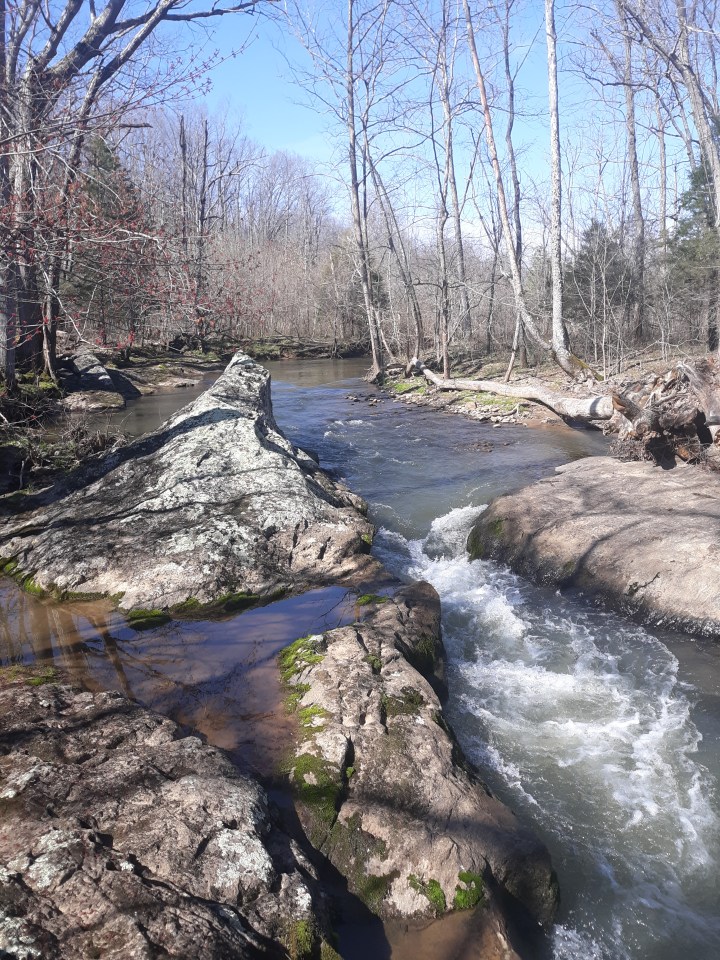
A couple months ago, I was on a walk with my family along the James River when we saw a bald eagle. I have seen many bald eagles in my life, but infrequently enough that it is always a little exciting to see one. Typically, someone points out where they are perched in a tall tree. They look like any other bird except for their white head.
This time though, it was only a few yards away and closer to the ground. It was clearly much bigger than other birds. It was perched on a tree trunk which was holding onto the edge of the earth, but leaning out over the water. Almost at the same time we noticed it, the eagle spread its wings wide and flew out of sight across the river.
The other week, I was biking along Blackwater Creek Trail. I had just started and still had plenty of energy when out of the corner of my eye, I saw a streak of blue and grey. It was a heron flying along the creek, using it almost as a roadway, turning as it turned. It was so elegant. I had a crazy moment when I thought maybe I could keep up with it on my bike and watch it a little bit longer. It was only in sight a few seconds before it flew around the bend and I was left far behind.
These two sightings were little reminders to be thankful I live in a place with regular opportunities to be close to nature. Though herons are more plentiful, I also know that I probably wouldn’t have seen many eagles a few decades ago. I wondered to what I owed these pleasures. Surely, God is an awesome creator and all the beauty and majesty of the earth praises him! But what about the stewardship of man? What have the caretakers done to preserve this aspect of creation?
I did some reading and found out that bald eagles were first protected by law in 1940. For the first time, there were restrictions on directly hunting bald eagles. Unfortunately in the next few years, as DDT and other environmental concerns cropped up, bald eagles were threatened much more by indirect harm than they had been by hunting. In the 1960s, there were fewer than 500 nesting pairs in the whole country. In the 1970s, the Clean Air Act, Endangered Species Act, and Clean Water Act were all passed. The Clean Water Act was the most important of these for bald eagles as it protected fish, their primary source of food.
Bald eagles were taken off the Endangered Animals list in 2007 and have been thriving, quadrupling numbers since then. They are at approximate numbers which would have existed in the 18th century when the bird inspired the founding fathers to place it on our national seal. This Smithsonian article was interesting reading if you are curious for more details.
There is much to be done in terms of good stewardship, but also successes to celebrate. Happy Earth Day! What animals or plants excite you when you see them in the wild?
 Welcome To The Carriage House